I led Bing Shopping design for four years, across three shifts in search: result matching,
intent-based orchestration, and AI-generated pages. The old SERP pattern was no longer enough, but the
replacement was not obvious. My direction came from real shopping behavior: search is not chat.
Instead of forcing chat patterns onto search, I used AI to make the layout more useful for decisions.我在 Bing Shopping 做了四年 design owner,完整经历了搜索的三次变化:结果匹配、按意图编排、
以及 AI 生成页面。旧的 SERP 形态不再够用,但替代方案并不天然清晰。我的判断来自真实购物行为:search
不是 chat。我没有把 search 硬改成对话,而是用 AI 让 layout 更服务于决策。
−0.23 → −0.13WPSBS gap vs. competition, closed by ~10 pts对竞品 WPSBS gap 收窄约 10 个点
+23%CCR on Top Products answerTop Products answer 点击转化
63–69%APSAT win-rate across Magazine layouts多个 Magazine layout 的 APSAT 胜率
+20% YoYrevenue across Algo + STP surfacesAlgo + STP 面上营收同比增长
Bing Shopping is a small slice of search, but a clear lens on how search changed. Each
product cycle forced us to redesign not only UI, but the logic of what to show first. Formats changed
repeatedly; user goals did not.Bing Shopping 在搜索里只是一个切片,但它很能说明搜索是怎么变的。每一轮产品迭代,
我们重做的不只是 UI,还包括“什么信息该先出现”的逻辑。形态一直在变,用户目标没有变。
Goal目标
Help users find what they need efficiently, and improve satisfaction with shopping answers.帮助用户高效地找到所需,并提升他们对 shopping answer 的满意度。
In practice, this work moved through three stages: matching, orchestration, and guidance.落到设计实践上,这段工作经历了三个阶段:匹配、编排、引导。
Matching → Orchestration → Guidance.匹配 → 编排 → 引导。
Phase 1 · The most primitive search阶段一 · 最原始的搜索
Design = Matching设计=匹配
Result MatchingResult Matching · 结果匹配
Insight洞察
In Phase 1, shopping answers were distributed by query-product match quality. The same card
had to work in different SERP slots, in the Shopping vertical, and later across Microsoft surfaces.
So I treated the card as a reusable spec, not a one-off component.在阶段一,shopping answer 按 query 与商品匹配度分发。同一张卡片要同时适配不同 SERP 点位、
Shopping vertical,以及后续跨微软产品语境。所以我把它当成可复用规范,而不是一次性组件。
drag →
The same shopping answer, placed across different SERP positions — each slot a different width, density and neighbouring context.同一套 shopping answer,投放在 SERP 的不同位置——每个点位的宽度、密度与上下文都不同。
Challenge挑战
Hard priority calls in tight space. Which fields must stay, which can be compressed,
and what cannot be hidden at all for purchase decisions.在有限空间里做优先级取舍。哪些字段必须保留,哪些可以压缩,哪些对决策绝不能隐藏。
Two consistency systems in tension. The card needed to align with Bing's own
design language while also fitting a cross-Microsoft shopping experience.两套一致性同时拉扯。卡片既要遵循 Bing 自身设计语言,也要融入跨微软的 shopping 体验。
Solution解法
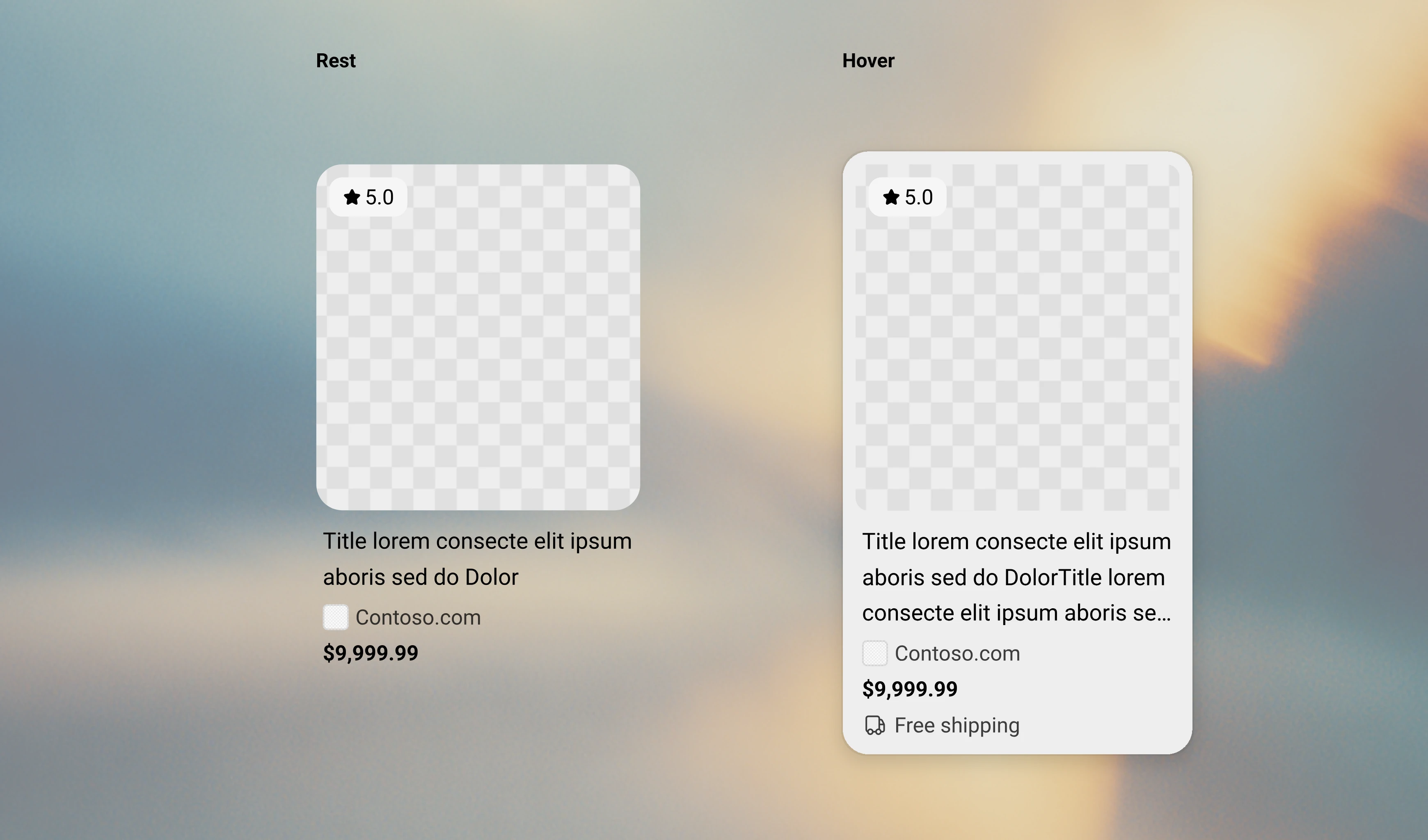
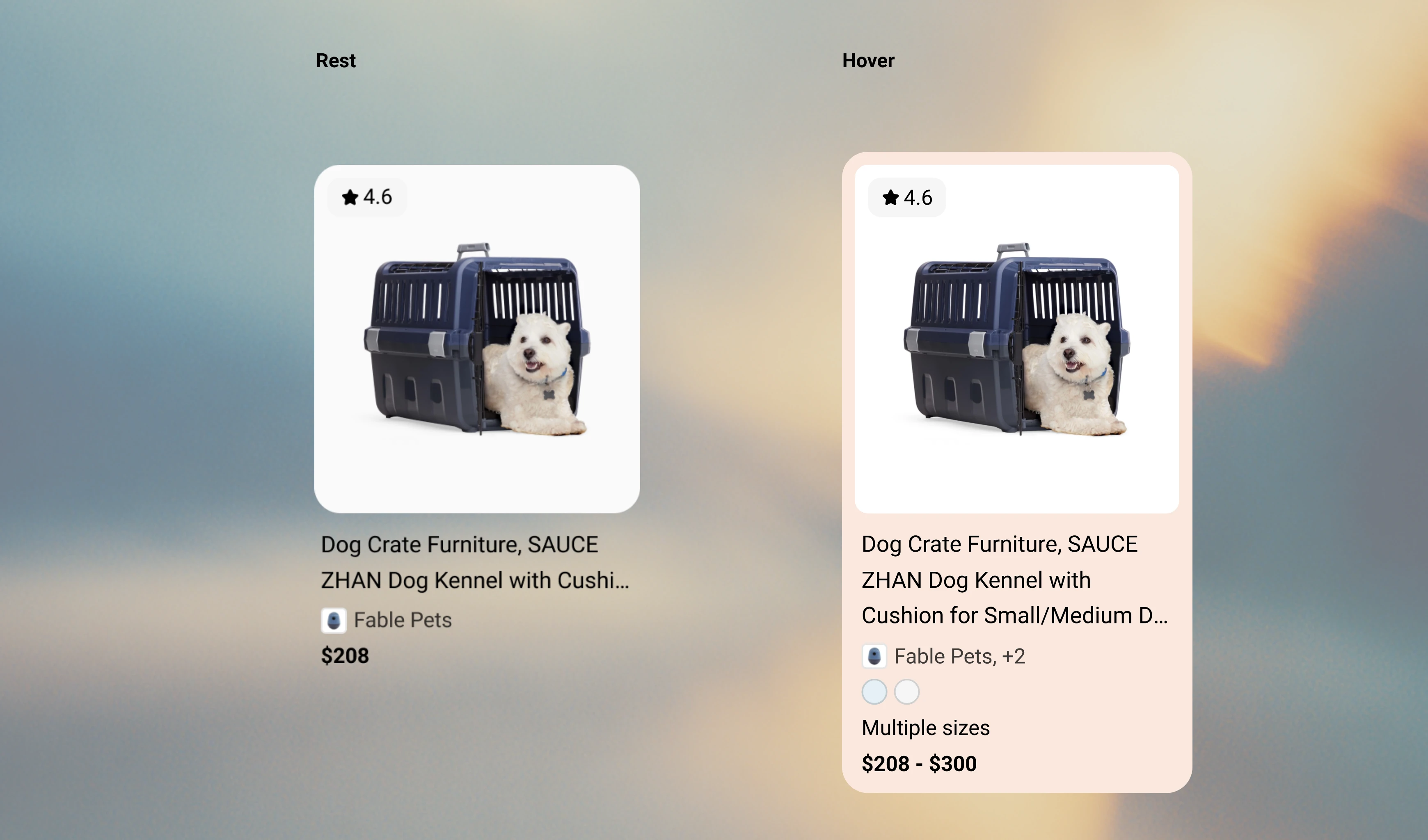
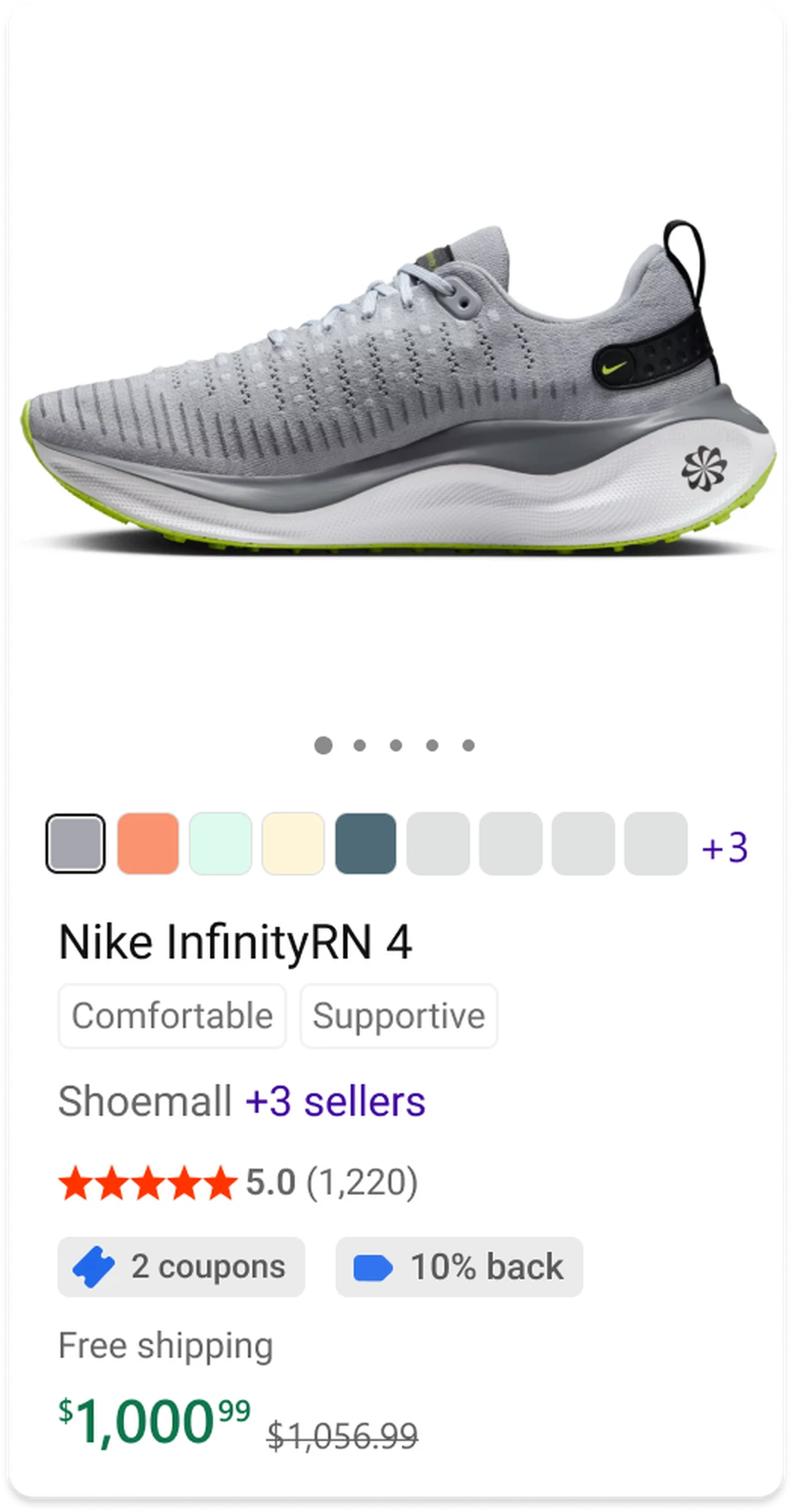
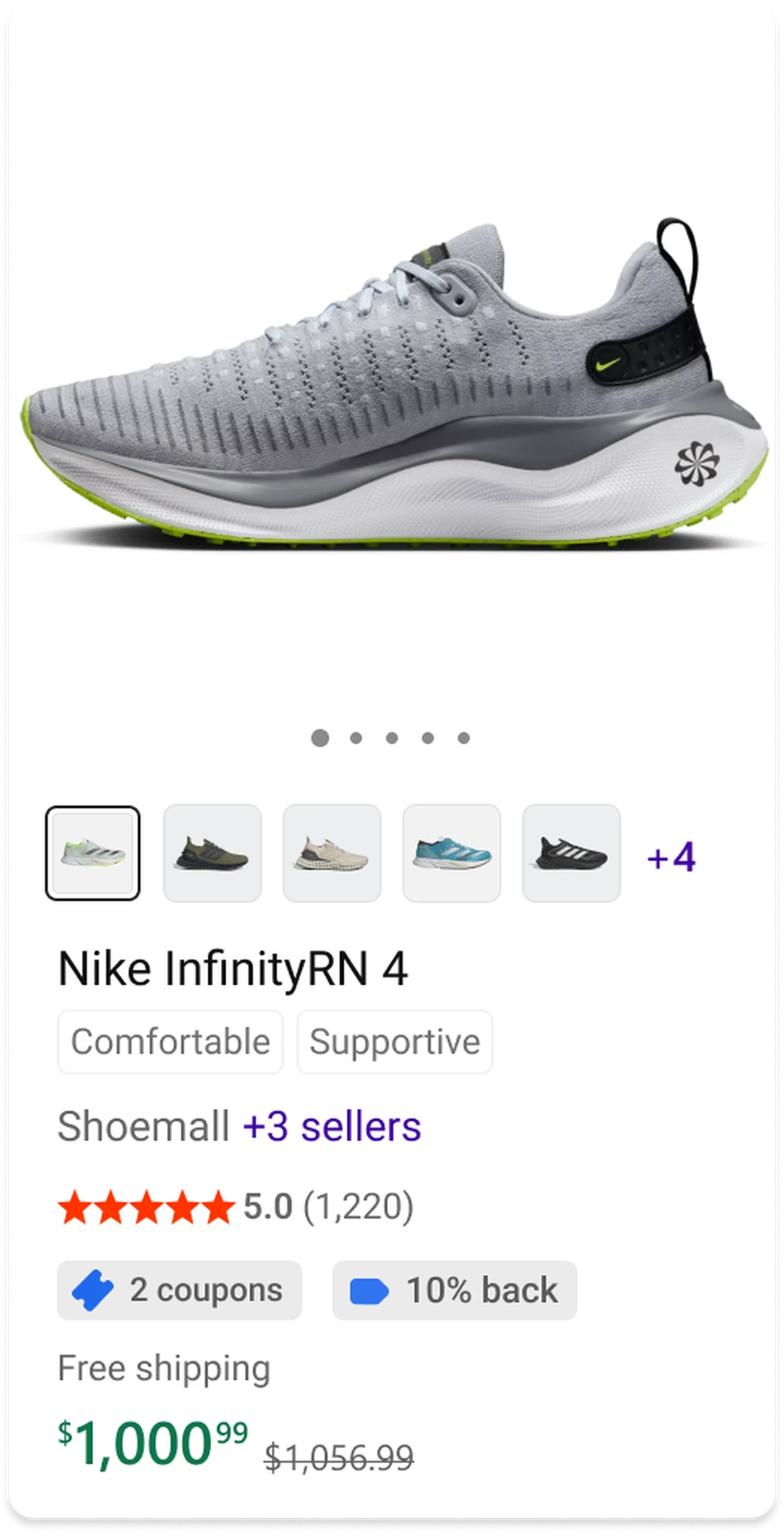
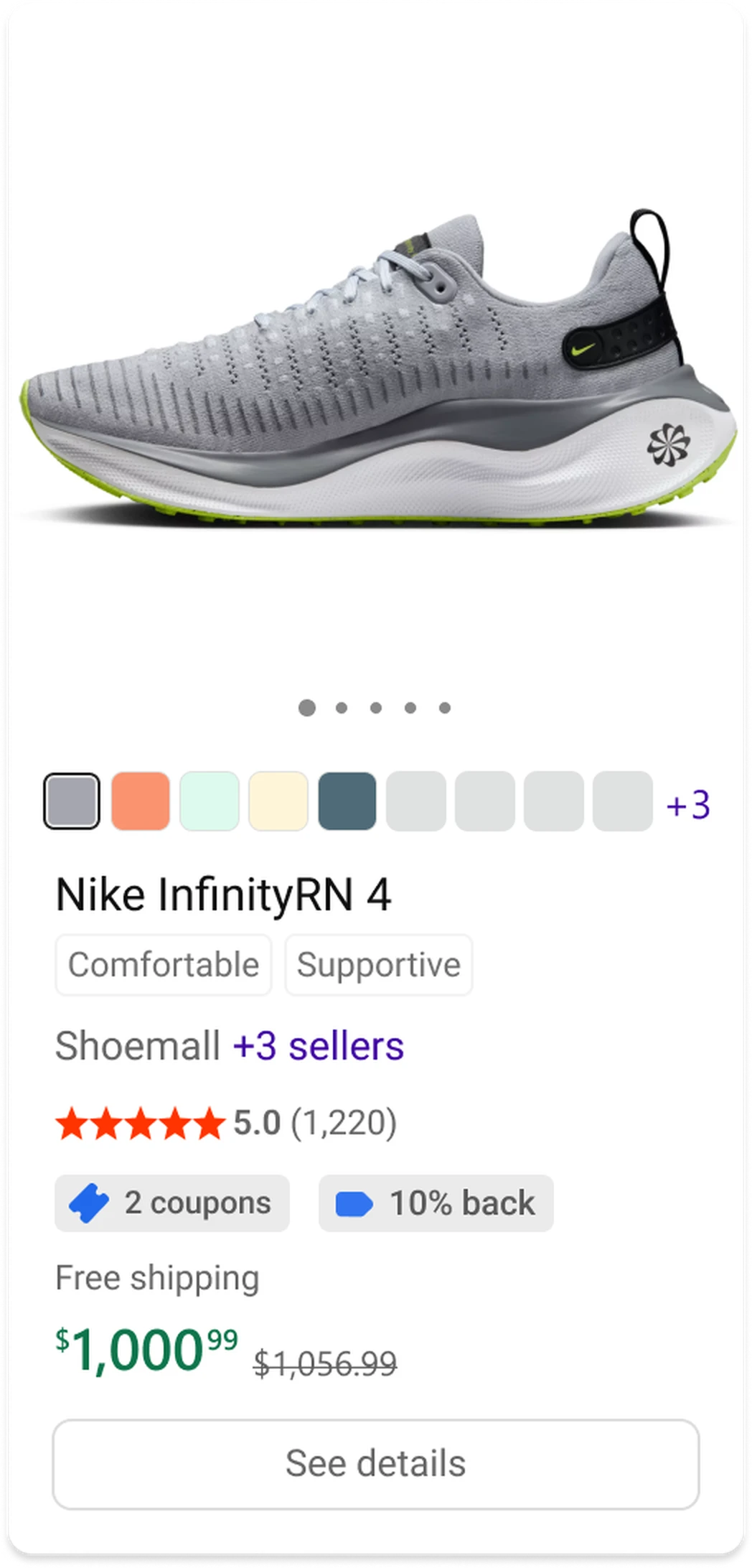
I decomposed the card into fields (Image, Title, Price, Ratings, Sellers, SKUs, Hashtags,
Shipping, CTA) and prioritized them using flight data plus user research, not visual preference.
To resolve the consistency tension, I set one rule:我把商品卡拆成 Image、Title、Price、Ratings、Sellers、SKUs、Hashtags、Shipping、CTA 等字段,
并用flight 数据与用户研究确定优先级,而不是靠审美拍板。为解决一致性冲突,我定下一条规则:
Content follows intent; form follows canvas.内容层跟随用户意图,表达层跟随产品语境。 Content follows intent; form follows canvas.
If intent is the same, content priority stays the same; visual language can adapt by product
(radius, spacing, type). Across products, the stable anchor is user intent.只要 intent 相同,内容优先级就保持一致;视觉语言(圆角、间距、字号)可以随产品调整。
跨产品不变的锚点是用户意图。
The card as a spec: an empty shell, the spacing rules drawn over its rest and hover states, real content poured in — then extended into a set, and every field named.把卡片当成一套规范:空壳 → rest 态间距规则 → hover 态与真实内容 → 延展成一组 → 逐字段命名。
Outcome结果
This principle became the basis for a body of shipped work across Bing's shopping
surfaces, moving traffic and revenue at scale (rich nav +43k DAU and ~$1.2M revenue;
image collage +50k DAU and $3–4M) and beginning to close the WPSBS gap against competition.这条原则成了一批真实上线工作的基础,铺开到 Bing 的各个 shopping 面上,
带来规模化的流量与营收增长(rich nav +43k DAU、约 $1.2M 营收;
image collage +50k DAU、$3–4M),并开始收窄对竞品的 WPSBS gap。
A single card pattern stopped being enough. Different queries imply different shopping
tasks, so answer composition needed to vary by intent. My first attempt split by query type; research
showed where that model failed.单一卡片范式已经不够。不同 query 对应不同购物任务,answer 组合必须随 intent 变化。
我最初按 query type 切分,但研究很快暴露了这个模型的边界。
Query type is not a reliable proxy for purchase intent.
The same query (for example, "nike shoes") can mean browsing, deep comparison, or near-purchase.
Intent is better inferred from the user's decision stage.query type 不是购买意图的可靠代理。同一个 query(如 "nike shoes")可能对应
浏览、深度比较或临近下单。意图更应从用户所处的决策阶段来判断。
Challenge挑战
No universal template per intent. We had to build hypotheses, then test them
against UX and live signals.不同 intent 没有现成标准模板。只能先建假设,再用 UX 与线上信号验证。
Scale pressure on SERP. The taxonomy had to be understandable, actionable,
and broad enough for massive query diversity.SERP 的规模压力。分类体系既要好理解、可执行,又要覆盖海量 query 多样性。
Solution解法
We began with high-traffic head queries, then reframed from "query type split" to
"decision stage + intent + category." For each class, we defined expected user needs and validated
them in UXLab and live data. This made composition decisions much sharper:我们先从高流量头部 query 入手,再把框架从“按 query type 切”重构为
“按决策阶段 + 意图 + 品类切”。每一类先定义用户期待,再在 UXLab 和线上数据中验证,
于是组合决策更精准:
drag →
User interviews showed that what people care about shifts with intent.通过用户访谈我们发现,不同 intent 下用户在意的东西并不一样:
Comparison queries run on sources. Users ask where a summary came from before
they decide whether to believe it — the sources carry the trust.比较类的商品 query。用户更在乎这份总结的来源,它决定了他们的信任程度。
Visual categories are the opposite. The product image does the work, and most
of the description turns into noise.视觉品类恰恰相反。商品的视觉呈现反而更吸引他们,大部分描述就成了噪音。
Broad exploration has to ask first. There is nothing useful to answer until
the question gets narrower.宽泛探索。不先问清楚,根本无从答起。
Serious comparison认真比较
Not a wall of tables: summary, verbatim quotes, and source trails from social and video. Users accept AI synthesis only when provenance stays visible.不是堆表格,而是“总结 + 原文引用 + 社交/视频来源路径”。用户接受 AI 总结的前提,是来源可追溯。
Apparel and home are image-led. If key attributes are visible, extra descriptive copy only consumes space.服饰和家居是强视觉场景。关键属性若已可视,再堆描述文案只会占屏。
Visual · Phase 2
Visual-category answer: image-first layout for apparel/home视觉品类 answer:服饰/家居的图像优先布局
assets/shopping/p2-intent-visual.png
Broad exploration宽泛探索
For gifting, clarify occasion, budget, and recipient first, then offer themed inspiration and grouped options.gift 场景先澄清场合、预算、对象,再给主题化灵感和分组选项。
Outcome结果
This answer family (Single Product, Gifting, Magazine, Top Products) shipped as one
system. Top Products raised CCR by +23%; Magazine won APSAT in
63–69% of comparisons. The Single Task Pane I led on SERP improved WPSBS by
+12.3 in its triggered set, and Algo+STP revenue grew ~20% YoY.
I owned this stream end-to-end, from framework definition to answer composition.这套 answer(Single Product、Gifting、Magazine、Top Products)作为同一体系上线。
Top Products 的 CCR 提升 +23%;Magazine 在
63–69% 的对比中赢得 APSAT。我主导上线 SERP 的 Single Task Pane,
在触发集上带来 +12.3 的 WPSBS 提升;Algo+STP 面营收同比增长
约 20%。这条线从框架定义到 answer 组合均由我端到端负责。
Phase 3 · AI arrives阶段三 · AI 来了
Design = Guidance设计=引导
Progressive AI Guidance — GenSERPGenSERP · AI 渐进式引导
Insight洞察
Phase 3 moved from curated templates to query-level generation. In GenSERP, page structure
is assembled in real time per query. While much of the industry defaulted to chat UI, we found that
search behavior is still browse → compare → narrow, so pure chat interaction was a mismatch.阶段三从“人工配置模板”进入“按 query 实时生成结构”。在 GenSERP 中,页面结构会随每条 query 动态组装。
行业普遍转向 chat 形态,但我们发现搜索行为依旧是 浏览→比较→收敛,纯对话交互并不匹配。
Challenge挑战
Define a search-native AI interaction. We needed guidance patterns tailored to search,
not a copy of generic chat logic.定义搜索原生的 AI 交互。需要的是适配搜索的引导机制,而不是照搬通用 chat 逻辑。
Keep quality under infinite variation. With pages generated dynamically, we needed a
durable system for hierarchy, consistency, and experience baseline.在无限变体中守住质量。当页面动态生成时,必须有稳定机制去约束层级、一致性和体验下限。
Evolution演进
Step 1 — AI enhances informationStep 1 — AI 增强信息
Question:What can AI add to information users already have?
Shopping information sits in pieces: specs here, reviews there, prices somewhere else. AI can put the pieces together—a price trend, the complaint that keeps coming up in reviews. But a summary nobody can check is worse than no summary, so I made every claim carry its source, visible and clickable, rather than asking users to trust the model.问题:AI 能给已有的信息加什么?
AI summaries, signals, and cited insights inside search results搜索结果中的 AI 总结、信号与可追溯洞察
assets/shopping/p3-step1-ai-info.png
Step 2 — AI adapts the experienceStep 2 — AI 自适应体验
Question:How should the page change as the decision changes?
A static page answers every query the same way. Here the page is assembled per query: someone still browsing gets breadth, someone comparing gets a table, someone close to buying gets sellers and price. The hard part was never a single layout—it was the rules underneath. Which section leads, what a click opens next, and when to stop adding.问题:决策在走,页面该怎么跟?
Question:If AI is the interface, what is left of search?
Not a chat window with a search box bolted on. Users still arrive with a query, so AI Mode starts from one—then holds the thread as it develops: compare these four, why this one, where is it cheapest. What stays from search is the shape of the answer. Every reply is still a page you can scan, not a paragraph you have to read to the end.问题:如果 AI 就是界面,搜索还剩下什么?
不是给聊天窗口插一个搜索框。用户还是带着一个 query 来的,所以 AI Mode 也从 query 开始——然后把话头接下去:这几双帮我比一下、为什么是它、哪里买最便宜。从搜索里留下来的是答案的形状:每一次回答依然是一页可以扫的结构,而不是一段必须读到底的话。
Visual · Phase 3 · Now
Category + use case — entering AI Mode from “trail running shoes”品类 + 使用场景:从“trail running shoes”进入 AI Mode
assets/shopping/phase3/p3-now-entry-usecase.png
Visual · Phase 3 · Now
Category + brand — entering AI Mode from “Apple laptops”品类 + 品牌:从“Apple laptops”进入 AI Mode
assets/shopping/phase3/p3-now-entry-brand.png
Visual · Phase 3 · Now
AI Mode: clarify, follow up, and narrow the decisionAI Mode:澄清、追问,并逐步收窄决策
assets/shopping/phase3/p3-now-ai-mode.png
Outcome结果
AI-era search does not have to become chat. Chat is one AI interface;
search has another: structured pages plus progressive guidance. That combination helps users turn vague needs
into concrete choices while preserving familiar search behavior.AI 时代的搜索不必变成 chat。Chat 只是 AI 的一种界面;搜索可以是另一种:
结构化页面 + 渐进式引导。它既能把模糊需求收敛成可决策选项,也保留用户熟悉的搜索行为。
—Reflection反思
The core that even AI couldn't move连 AI 都没能撼动的那个内核
Across four years and three phases, tools changed and methods changed. The core did not:
search exists to present information efficiently and help people decide better. AI did not replace that core;
it expanded what we can do with it.四年、三个阶段,工具在变、方法在变,但内核没变:搜索的价值仍是高效呈现信息,帮助用户更好决策。
AI 不是替代这个内核,而是放大它能做到的事。
AI changes the tool, not the question the designer has to answer —
what does the user actually want to accomplish.AI 换的是工具,不是设计师要回答的那个问题—— 用户到底想完成什么。